Miracolo d’Amore
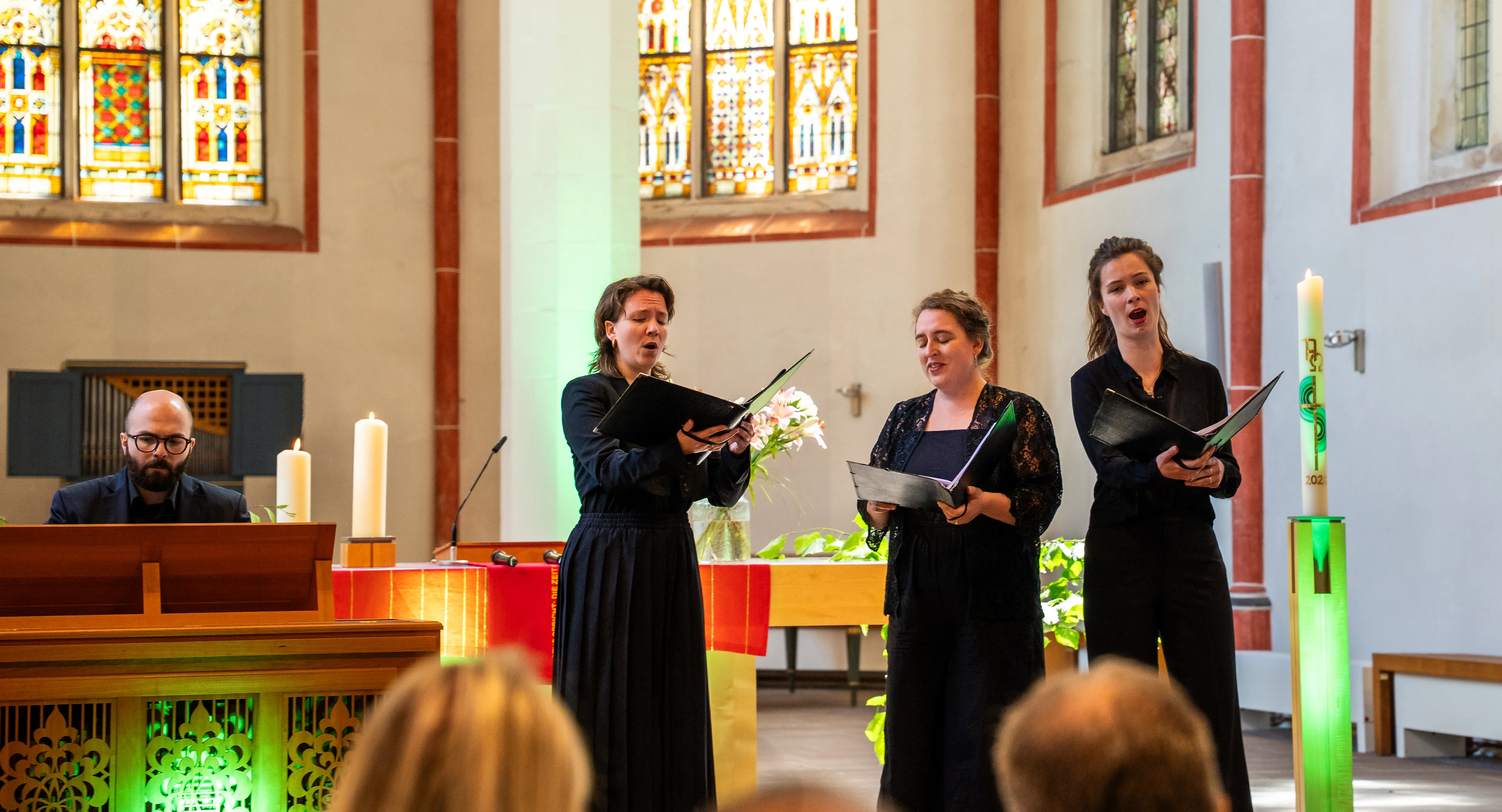
Arcadian entanglements of love in seventeenth-century Italy: a concert in five acts. Between the Garden of Venus and Arcadia unfolds a musical journey through madrigals, canzonettas and arias by Monteverdi, Mazzocchi, Strozzi, d’India, Luzzaschi and Sances, loosely inspired by Giovanni Battista Guarini’s Il pastor fido.
Practical information
- Composers
- Mazzocchi · Strozzi · Luzzaschi · Sances · D’India · Monteverdi · Cazzati
- Instrumentation
- CCATB and continuo (hps/org)
- Duration
- ca 55 min
Programme
- Prologo
Mazzocchi — Uscite a mille a mille
- ca 2:40
- CCATB
- Madrigali a cinque voci, e d’altri varii Concerti (Rome, 1638), no. 1.
Uscite a mille, a mille dal mio petto, o sospiri
Go forth by the thousands, by the thousands, from my breast, o sighs
Ch’entro a musici giri raccor vi deve
which must gather you within musical rounds
e poi spiegarvi al vento
and then unfurl you to the wind:
L’adorata cagion del mio tormento
the adored cause of my torment.
E così risonar faravvi Amore
And thus Love will make you resound
Ne le sue labra almen, se non nel core.
in her lips at least, if not in her heart.
Text: Pier Francesco Paoli (1585–c. 1638)•Translation: Tempera Mente
- Act I — In Venus’ Garden
Strozzi — Le tre grazie a venere
- ca 3:20
- CCC bc
- Op. 1/11·Il Primo Libro di Madrigali, op. 1 (Venice, 1644).
Bella madre d’Amore
Beautiful mother of Love,
anco non ti ramembra
do you still not recall
che nuda avesti di bellezze il grido,
that when naked, you already had beauty’s renown,
In sul Troiano lido
on the Trojan shore,
dal giudice Pastore?
by the shepherd’s judgement?
Onde se nuda piaci
So if you even when naked please
In sin à gl’occhi de bifolchi idei
the eyes of the Idaean herdsmen,
vanarella che sei,
vain little thing that you are,
perché vuoi tu con tanti adobbi e tanti
why do you want, with so very many adornments,
ricoprirti a gl’amanti?
to cover yourself again before your lovers?
O vesti le tue Grazie e i nudi Amori
Oh, clothe your Graces and the naked Loves,
o getta ancor tu fuori
or else cast out as well
gl’arnesi I manti e i veli:
the gear, the mantles, and the veils:
di quelle care membra
of those dear limbs
nulla si celi.
let nothing be hidden.
Tu ridi e non rispondi
You laugh and do not answer,
Ah tu le copri si tu le nascondi
ah, you cover them, yes, you hide them
Che sai ch’invoglia più che più s’apprezza
for you know that the more it is prized, the more it entices,
la negata bellezza.
beauty that is denied.
Text: Giulio Strozzi (1583 - 1660)•Translation: BC/Tempera Mente
Mazzocchi — Pian piano
- ca 5:00
- CCATB bc
- Madrigali a cinque voci, e d’altri varii Concerti (Rome, 1638), no. 8.
Pian piano, aure tranquille
Hush, hush, quiet winds
non destate costei.
do not wake her up.
Dormono i dolor miei;
My sorrows sleep;
deh, fermatevi! o venti:
ah, stop!, winds:
dormono i miei tormenti.
my torments rest.
Ma destatela pur, che mai non posa
In fact, wake her!, for is never asleep
beltà crudel che m’è nel petto ascosa.
the cruel beauty concealed in my bosom.
Text: Alessandro Adimari (1579–1659)•Translation: Campelli/CPLD
Luzzaschi — Non sà che sia dolore
- ca 2:30
- SSS bc
- Madrigali per cantare e sonare a uno e doi e tre Soprani (Rome, 1601), no. 11.
Non sà che sia dolore
He does not know what sorrow is
Chi da la vita sua parte, e non more.
who parts from his own life and does not die.
Cari lumi leggiadri, amato volto,
Dear graceful eyes, beloved face,
Ch’Amor mi diè si tardo e fier destino
to whom Love, having given me so slow and fierce a fate,
Si tosto hoggi m’ha tolto;
has today so swiftly taken from me;
Viver lungi da voi? Tanto vicino
To live far from you? Yet I am so close
Son di mia vita al termine fatale
to the fatal end of my life
Se vivo torno a voi, torno immortale
that if I return to you alive, I return immortal.
Text: Giovanni Battista Guarini (1538–1612)•Translation: Tempera Mente
- Act II — Struck by Cupid’s Arrow
Sances — Che sperasti o mio cor
- TB bc (transposed)
- Capricci poetici (Venice, 1649), no. 10.
Che sperasti o mio cor
What did you hope for, o my heart,
forse sempre goder d’amor gioire
perhaps always to enjoy love’s rejoicing,
Ah non si può goder senza languire.
Ah, one cannot enjoy without languishing.
Se provasti la gioia
If you tasted joy,
or prova pianti ognor
now feel weeping forever,
sospiri e noia
sighs and vexation.
Che credeste occhi miei
What did you believe, my eyes,
guardi sempre veder per voi pietosi
you would always see glances forever pitying toward you,
Ah che per crudeltà son più sdegnosi
ah, through cruelty they are only the more scornful.
Se godeste i bei sguardi
If you delighted in those lovely glances,
or prova pianti ognor
now feel weeping forever,
saette e dardi
arrows and darts.
Non pensar dunque o cor
Do not think, then, o heart,
a sì lieto gioir fuor di tormento
of such joyful mirth free of torment,
che viver non si può sempre contento
for one cannot always live content,
e se pur ben rimiri
and if indeed you look closely,
paghi per un piacer mille sospiri.
you pay a thousand sighs for a single pleasure.
Text: Anonymous•Translation: Tempera Mente
D’India — Dispietata pietate
- ca 2:30
- CCATB bc
- Il Terzo Libro de Madrigali a 5 (1615), no. 1.
Dispietata pietate
Pitiless pity
fu la tua veramente, o Dafne, allora
was yours truly, O Daphne, then,
che ritenesti il dardo:
when you held back the dart:
però che’l mio morire
for my dying
più amaro sarà quanto più tardo.
will be more bitter the later it comes.
Ed or perché m’avvolgi
And now why do you lead me around
per sì diverse strade e per sì vari
by such diverse paths and such varied
ragionamenti invano? Di che temi?
reasonings, in vain? What do you fear?
Temi ch’io non m’uccida?
Do you fear that I might kill myself?
Temi del mio bene.
You fear for my own good.
Deh, lasciami morire in tante pene.
Ah, let me die amid so many pains.
Text: Torquato Tasso (1544-1595), Aminta•Translation: Tempera Mente
D’India — Dove potrò mai gire
- ca 5:00
- CC bc
- Le Musiche da cantar solo (Milan, 1609), no. 56.
Dove potrò mai gir tanto lontano
Where could I ever go so far
Ch’io non senta d’Amor l’acuto strale
that I would not feel Love’s sharp arrow,
Dove mai fugirò che non sia invano
where could I ever flee that it would not be in vain,
Innanzi a quel ch’ha sì veloci l’ale.
before him who has such swift wings?
Dove n’andrò che quella bianca mano
Where shall I go, that that white hand
E quei begl’occhi dond’Amor m’assale,
and those lovely eyes from which Love assails me
Non mi sia sempr’inanzi in ogni loco
would not always be before me in every place,
Si ch’arda più quant’ho più lung’il foco.
so that it burns all the more, the longer I hold the fire?
Text: Unknown•Translation: Tempera Mente
D’India — Langue al vostro languir l’anima mia
- ca 4:00
- TB bc
- Le Musiche a due voci (Venice, 1615), no. 2.
Langue al vostro languir l’anima mia,
My soul languishes at your languishing,
e dico: “Ah, forse a sì cocente pena
and I say: “Ah, perhaps to such burning pain
sua ferità la mena.”
her harshness drives it.”
O anima d’Amor troppo rubella,
O soul too rebellious against Love,
Quanto meglio vi fora
how much better it would be for you
provar quel caro ardor che vi fa bella
to feel that dear ardor that makes you beautiful
che quel che vi scolora?
than that which makes you pale?
Perché non piace alla mia sorte ch’io
Why does my fate not consent that I
arda del vostro foco e voi del mio
should burn with your fire, and you with mine?
Text: Giovanni Battista Guarini (1538–1612)
- Act III — Sweet Flames, Tender Kisses
Monteverdi — Cor mio mentre vi miro
- ca 2:10
- CCATB
- SV 77·Il quarto libro de Madrigali a cinque voci (Venice, 1603), no. 2.
Cor mio mentre vi miro
My heart, while I gaze upon you,
visibilmente mi trasforma in voi
visibly transforms me into you;
e trasformato poi
and I, so transformed, then
in un solo sospiro l’anima spiro.
breathe out my soul in a single sigh.
O bellezza mortale
O mortal beauty,
o bellezza vitale
o beauty full of life,
poi che sì tosto un core
since a heart, so swiftly,
per te rinasce e per te nato more.
is reborn for you, and, once born, for you dies.
Text: Battista Guarini (1538–1612)•Translation: Tempera Mente
Strozzi — I baci
- ca 3:00
- CC bc
- Op. 2/23·Cantate, ariette, e duetti, op. 2 (Venice, 1651), no. 23.
Oh dolci, oh cari, oh desiati baci!
Oh sweet, oh dear, oh desirable kisses!
Unite l’alme vanno
United souls come
sul labro ad incontrarsi.
on these lips to meet,
Col bacio l’alme fanno
with a kiss these souls
nel cor gran colpi darsi.
are able to strike at the heart.
Vezzosette si accordano;
Charmingly they reconcile,
viperette si mordano.
spitefully they bite,
Ma sono i lor dolcissimi furori
but it is in their sweet battle
grand union dei cori.
that hearts are joined.
Oh dolci, oh cari, oh desiati baci!
Oh sweet, oh dear, oh desirable kisses!
Bacia, mia bocca, e taci!
Kiss my lips, kiss, and be silent.
Text: Anonymous•Translation: Rosemary Galton/CLPD
Cazzati — Mio bene voi m’affligete
- CB bc
- Duetti per camera, op. 66 (Bologna, 1677).
Mio bene, voi m’affligete,
My love, you afflict me,
Mio bene, voi m’uccidete
my love, you kill me
all’or, che miro, il vostro bel sembiante,
whenever I gaze upon your beautiful face,
allor che scorgo il vostro bel sembiante.
whenever I behold your beautiful face.
Mia vita i vostri lumi,
My life, your eyes,
mia vita i vostri sguardi,
my life, your gazes,
mi dan martire,
give me torment,
ch’ogn’or mi fan morire.
which make me die every hour.
Oh Dio, vivi mio core
Oh God, live, my heart,
Mio caro in te respiro
my dear, in you I breathe,
mio ben per te sospiro.
my love, for you I sigh.
M’ami? M’ami? Sì sì.
Do you love me? Do you love me? Yes, yes.
Il vago tuo viso ucciso
Your lovely face has slain
il cor mi rapì.
and stolen away my heart.
Mi voi? mi voi? Sì sì.
Do you want me? Do you want me? Yes, yes.
Di questa mia salma,
From this my body
già l’alma,
the soul has already
in te se’n fuggì.
fled into you.
Oh soave martire,
Oh sweet torment,
ò felice gioire.
oh joyful rejoicing.
Di ben’unito Amore in segni espressi
May our embraces, signs expressed of a well-united love,
sian catene de l’alme i nostri amplessi.
be the chains of our souls.
Text: Anonymous•Translation: Tempera Mente
- Act IV — Labyrinth of Hearts
Monteverdi — Ch’io t’ami, e t’ami più de la mia vita
- ca 9:00
- CCATB
- SV 98·Il quinto libro de Madrigali a cinque voce (Venice, 1605), no. 9.
Ch’io t’ami, e t’ami più de la mia vita,
That I love you, and love you more than my own life,
se tu nol sai, crudele,
if you don’t know this, you cruel one,
chiedilo a queste selve,
ask these very woods;
che tel diranno, e tel diran con esse
they will tell you so, and together with them,
le fere loro e i duri sterpi e i sassi
their wild beasts, the hard thorn-thickets, and the stones
di questi alpestri monti,
of these rugged mountains,
ch’io ho sì spesse volte
which I have so often
intenerito al suon de’ miei lamenti.
moved to pity with the sound of my laments.
Deh bella e cara e sì soave, un tempo
Ah, beautiful, dear, and once so sweet
cagion del viver mio mentre al ciel piacque,
cause of my very life, while heaven still willed it,
volgi una volta, volgi
turn back to me once more, oh turn
quelle stelle amorose,
those love-lit stars,
come le vidi mai, così tranquille
as calm as I have ever seen them,
e piene di pietà, prima ch’i’moia,
and full of tenderness, before I perish;
che ‘l morir mi sia dolce.
so that death itself may taste sweet to me.
E dritto è ben che se mi furo un tempo
And it is only right that, if they were once to me
dolci segni di vita, or sien di morte.
sweet tokens of life, they now be tokens of death,
Quei begli occhi amorosi,
those lovely, loving eyes;
e quel soave sguardo,
and that gentle glance
che mi scorse ad amare,
that first led me into love,
mi scorga anco a morire;
let it lead me now to death as well;
e chi fu l’alba mia,
and let her who was once my dawn
del mio cadente dì l’espero or sia.
now become the evening star of my fading day.
Ma tu, più che mai dura,
But you, more unyielding than ever,
favilla di pietà non senti ancora.
still feel not the faintest spark of pity;
Anzi t’inaspri più quanto più prego.
indeed you only grow more bitter, the more I beg.
Così senza parlar dunque m’ascolti?
So, saying nothing at all, is this how you hear me?
A chi parlo, infelice, a un muto sasso?
To whom am I speaking, wretch that I am? To a silent stone?
S’altro non mi vuoi dir, dimmi almen mori,
If you’ll tell me nothing else, then at least say this: “Die!”
e morir mi vedrai.
And you shall watch me die.
Questa è ben, empio amor, miseria estrema,
This, pitiless Love, is misery’s very extreme:
che sì rigida ninfa
that so unyielding a nymph
non mi risponda, e l’armi
will not answer me, and that the weapon
d’una sola sdegnosa e cruda voce
of one single scornful, cruel word
sdegni di proferire al mio morir.
she scorns even to speak as I lie dying.
Text: Battista Guarini (1538–1612), Il Pastor Fido (1592), Act 3, scene 3•Translation: Tempera Mente
Sances — Dialogo a due. Pastore e Ninfa
- ca 6:00
- CT bc
- Capricci poetici (Venice, 1649), no. 11.
Pastore: Ninfa, ninfa!
Nymph, nymph!
Ninfa: E che vuoi da me?
And what do you want from me?
Pastore: Non m’ami?
You don’t love me?
Ninfa: Nò, nò, nò.
No, no, no.
Pastore: Dì il ver, non m’ami?
Say the truth, you don’t love me?
Ninfa: Il dissi pur testè: nò, nò, nò, ch’io non t’amo, nò.
I said it just now: no, no, no, that I don’t love you, no.
Pastore: Ah rigida! E perché…
Ah, harsh one! And why…
Ninfa: Tù sei troppo importuno, perché non vuò?
You are too insistent; why don’t you want it?
Pastore: Io moro.
I am dying.
Ninfa: Mori pur.
Die, then.
Pastore: Sì ch’io moro. M’ucciderei, s’havessi l’arco.
Yes, I am dying. I would kill myself, if I had the bow.
Ninfa: Hor te prendi il mio stral.
Now, you take my dart.
Pastore: Damel, damel, o cruda.
Give it to me, give it to me, o cruel one.
Ninfa: Ferma, ferma. Oimè, che fai?
Stop, stop! Alas, what are you doing?
Pastore: Quel ch’à te piace, io fò.
What pleases you, I do.
Ninfa: Nò, nò, nò, damm’il tuo stral.
No, no, no, give me your dart.
Pastore: Nò, nò, vuò morir.
No, no, I want to die.
Ninfa: Non più, damm’il mio stral, che la mia man t’ucciderà.
No more; give me my dart, for my hand will kill you.
Pastore: Sì, sì, sì, morrò più lieto. Uccidi tù.
Yes, yes, yes, I will die more gladly. You kill [me].
Ninfa: Nuda il petto.
Bare your chest.
Pastore: Ecco il nudo.
Here it is, bared.
Ninfa: Ah, che pur m’ha vinta la tua gran fede.
Ah, your great faith has won me over after all.
Ninfa e Pastore: Andianne sù, à cor frutti di gioia e di pietà.
Come, let us go now, wholeheartedly, to the fruits of joy and mercy.
Translation: Tempera Mente
- Act V — Arcadia
Luzzaschi — T’amo mia vita
- ca 3:30
- SSS bc
- Madrigali per cantare e sonare a uno e doi e tre Soprani (Rome, 1601), no. 10.
T’amo, mia vita la mia cara vita
‘I love you, my life,’ my dear life
Dolcemente mi dice, e’n questa sola
says to me sweetly, and in this one
sí soave parola
so sweet a word
par che trasformi lietamente il core,
it seems joyfully to transform my heart,
per farmene signore.
to make me its master.
O voce di dolcezza, e di diletto!
O voice of sweetness and delight!
Prendila tosto, Amore;
Take it quickly, Love;
stampala nel mio petto.
stamp it upon my breast.
Spiri solo per lei l’anima mia;
may my soul breathe only for it;
T’amo, mia vita, la mia vita sia.
‘I love you, my life’: let that be my life.
Text: Giovanni Battista Guarini (1538–1612), Rime, 1649, No. 66•Translation: Tempera Mente
Monteverdi — Luci serene e chiare
- ca 3:50
- CCATB
- SV 81·Il quarto libro de Madrigali a cinque voci (Venice, 1603), no. 7.
Luci serene e chiare,
Serene and clear eyes,
voi m’incendete, voi, ma provi il core
you set me afire, but the heart feels
nell’incendio diletto, non dolore.
in the burning, delight, not pain.
Dolci parole e care,
Sweet and dear words,
voi mi ferite, voi, ma prova il petto
you wound me, you; but the breast feels
non dolor nella piaga, ma diletto.
not pain in the wound, but delight.
O miracol d’amore!
O miracle of Love!
Alma ch’è tutta foco e tutta sangue
A soul that is all fire and all blood
si strugge e non si duol, more e non langue.
melts yet does not grieve, dies yet does not languish.
Text: Ridolfo Arlotti•Translation: Tempera Mente
Programme text
Miracolo d'Amore
Featuring a lovestruck shepherd, the Three Graces, a host of nymphs and shepherds, the programme leads the audience through the forests of Arcadia. Cupid lets fly his arrows in madrigals by Claudio Monteverdi, a forsaken lover laments his broken heart in a deeply expressive lament by Sigismondo d’India, while the Three Graces delight in the confusions of human love. The great masters of the Italian madrigal—Luzzasco Luzzaschi, Domenico Mazzocchi, Claudio Monteverdi and Sigismondo d’India—set texts by some of the most celebrated poets of their age, including Giovanni Battista Guarini, Torquato Tasso and Giulio Strozzi. The result is a musical journey into the Arcadian world of the Italian early Baroque, where love is at once miracle, wound and promise.